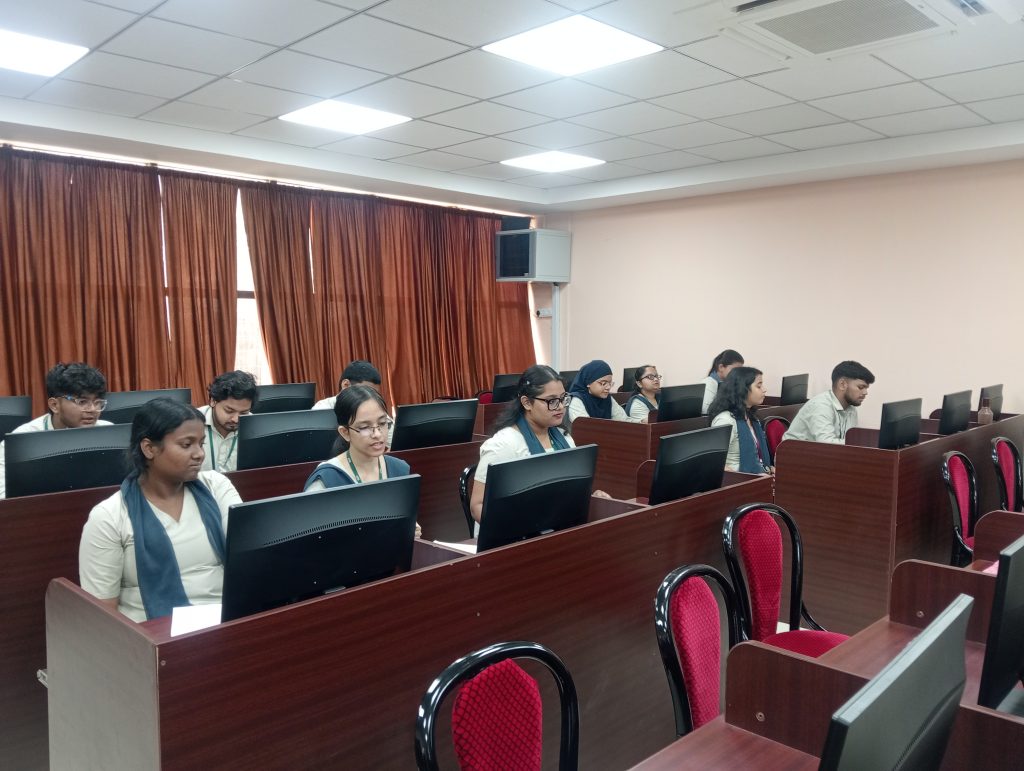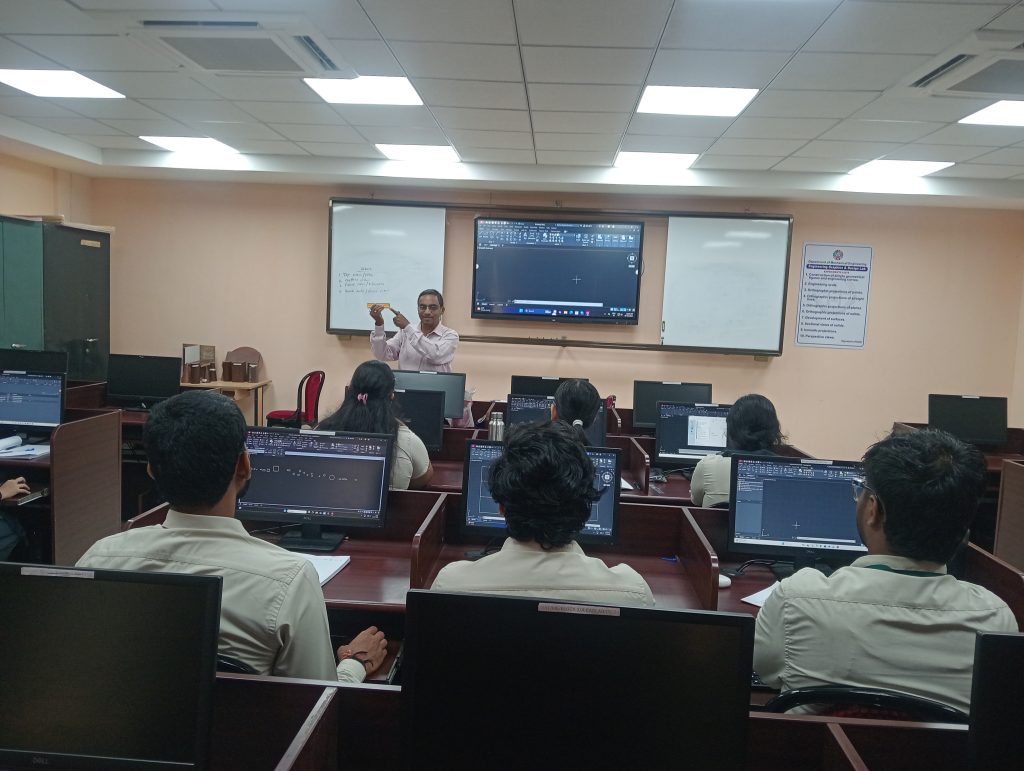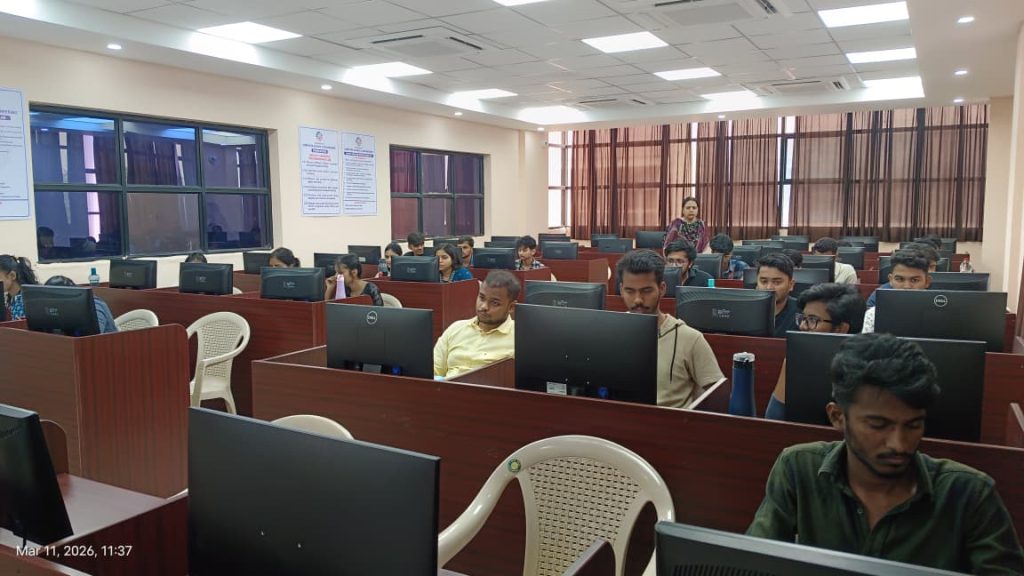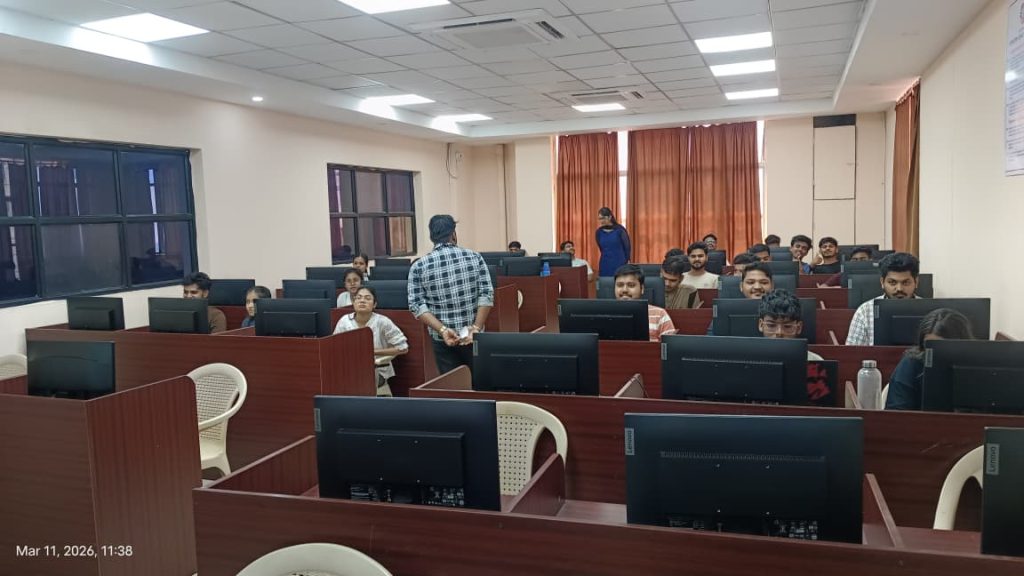
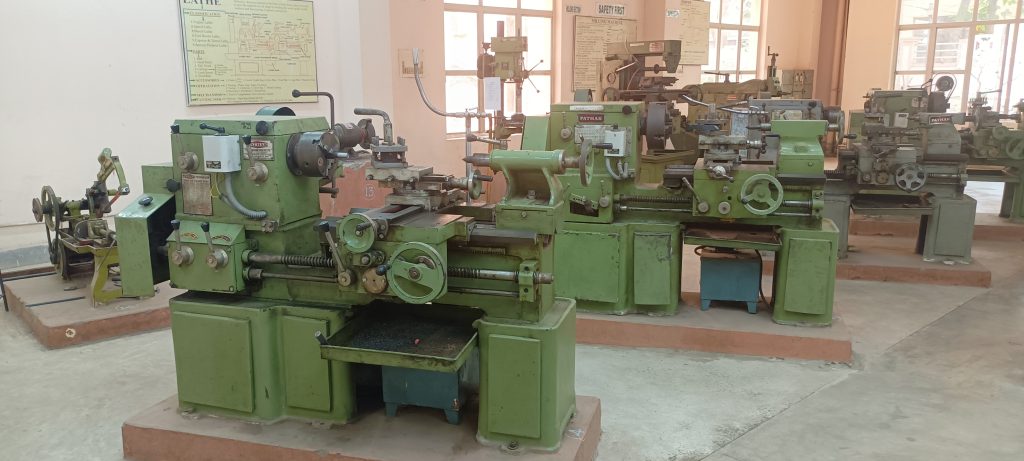
Workshop & Digital Manufacturing Lab

List of Experiments

  1. Preparation of job in fitting section / Study of lathe and turning operation.
  2. Preparation of job in blacksmith section / Study of milling machine and milling operation.
  3. Preparation of job in carpentry section / Milling operation on CNC milling machine.
  4. Study of CNC lathe machine and turning operation on CNC lathe.
  5. Study of Robot (Pick and Place and Palletizing operation).
  6. Study of additive manufacturing using 3D printer and product development.

1. Carpentry Section

Study of different hand tools, measuring instruments and equipment used in carpentry work along with safety precautions.

Preparation of Job:

Carpentry job involving different types of joints.

Operations Included:

  • Measuring
  • Marking
  • Sawing
  • Planing
  • Chiseling
  • Mortising
  • Tenoning
  • Half-lap joint
  • Mortise & Tenon joint
  • Nail joint

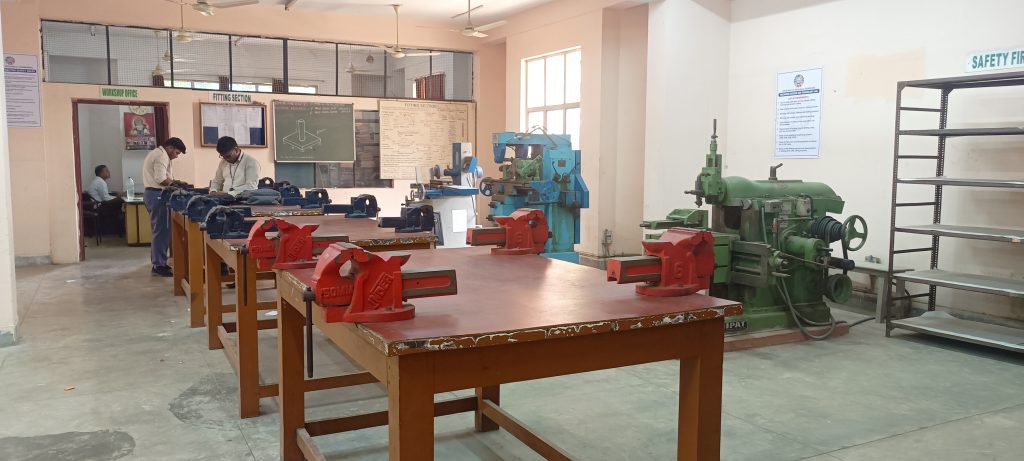
2. Fitting Section

Study of different hand tools, measuring instruments and equipment used in fitting work along with safety precautions. Study of drilling machine and grinding machine.

Preparation of Job:

Paper weight / Square or rectangular joint (male-female joint).

Operations Included:

  • Measuring
  • Marking
  • Filing
  • Sawing
  • Drilling
  • Tapping
  • Dieing
  • Punching

3. Blacksmith Section

Study of different hand tools, equipment and open hearth furnace used in blacksmith work. Study of different heat treatment processes and safety precautions.

Preparation of Job:

Weeding hook / Chisel.

Operations Included:

  • Measuring
  • Marking
  • Cutting
  • Upsetting
  • Drawing down
  • Bending
  • Fullering
  • Quenching

4. Turning / Milling Section (Conventional & CNC)

A. Lathe Machine

  • Study of lathe machine
  • Different parts and applications of lathe
  • Study of measuring and marking instruments

B. Milling Machine

  • Study of milling machine
  • Different parts and applications of milling machine
  • Study of measuring and marking instruments

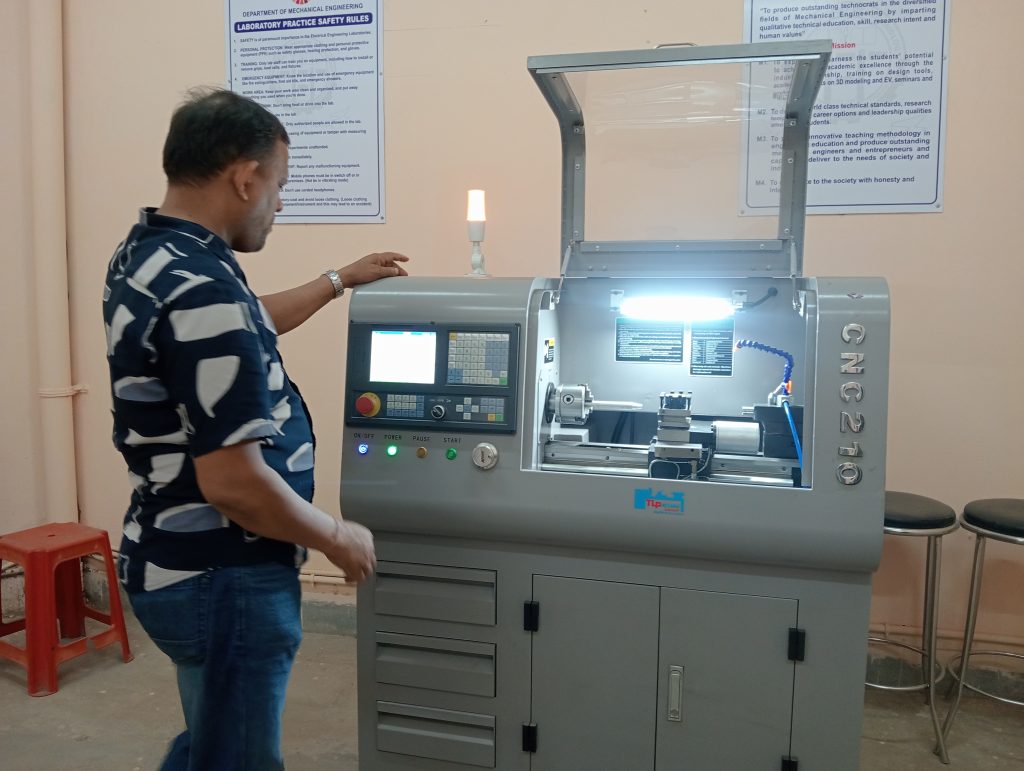
C. CNC Lathe

  • Study of CNC lathe machine and its parts
  • Part programming for turning operations

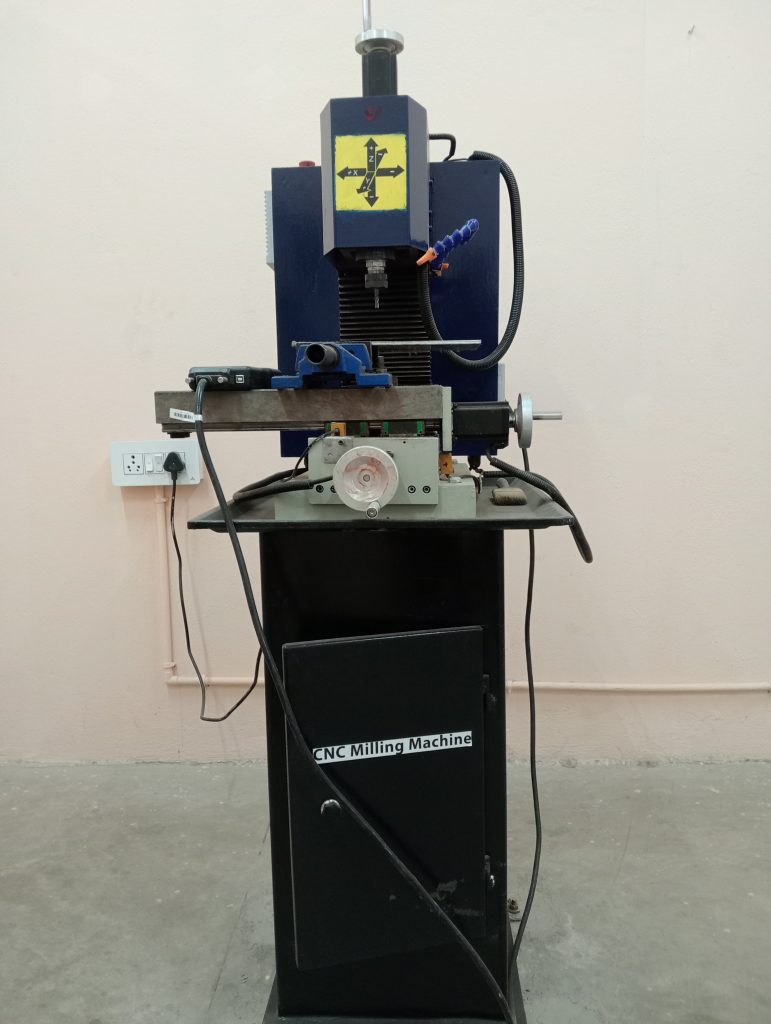
D. CNC Milling Machine

  • Study of CNC milling machine and its parts
  • Part programming for milling operations

5. Robotics Lab

  • Study of robot
  • Pick and place operation with demonstration and explanation of code
  • Palletizing operation with demonstration and explanation of code

6. Additive Manufacturing Lab

  • Study of 3D printer
  • Demonstration of additive manufacturing operation and product development
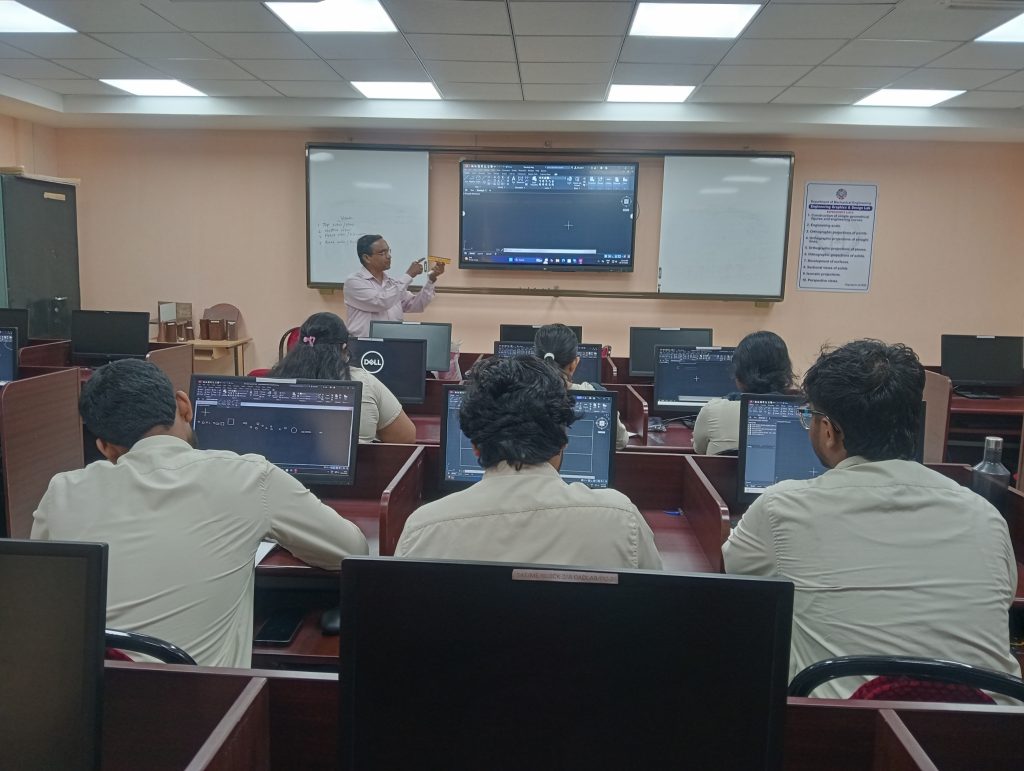
Engineering Graphics & Design Lab

List of Experiments

  1. Introduction to AutoCAD
    • Basic AutoCAD commands
    • Code provisions of IS-696 regarding lines, lettering and dimensioning
  2. Drawing of Scales
    • Plane scales
    • Diagonal scales
    • Vernier scales
    • Scales of chords
  3. Construction of Geometrical Figures
    • Simple geometrical constructions
    • Engineering curves
  4. Orthographic Projections
    • Projection of a point situated in various quadrants
    • Projections of straight lines
    • Projection of plane figures
    • Projection of simple solids
    • Section of solids and development of surfaces
  5. Isometric and Perspective Views
    • Isometric projection
    • Perspective view

Machine Drawing and Solid Modelling Lab

Course Objective

This laboratory course aims to develop students’ skills in creating detailed machine drawings and
3D solid models using Computer-Aided Design (CAD) software. By the end of the course,
students will be proficient in interpreting technical drawings, designing mechanical components,
and producing accurate models. These skills are essential for effective communication and design
in modern engineering practice.

List of Experiments

  1. Sketcher Workbench
    • Creating sketches
    • Selecting and editing geometry, features, and models
    • Creating sketcher geometry and using sketcher tools
    • Using sketches and datum features
  2. Basic Solid Part Modeling
    • Creating extrudes, revolves, and ribs
    • Creating holes, shells, draft, and patterns
    • Creating rounds, chamfers, and using layers
  3. Advanced Solid Part Modeling
    • Advanced selection, creating sweeps and blends
    • Sweeps with variable sections
    • Helical sweeps and swept blends
    • Relations, parameters, and family tables
    • Measuring and inspecting models
  4. Assembly Design
    • Creating assemblies using top-down and bottom-up approaches
    • Assembling with constraints, exploding assemblies, and replacing components
    • Cross-sections in assemblies
  5. Drafting Workbench
    • Introduction to drafting, creating new drawings and drawing views
    • Adding model details and tolerance information to drawings
    • Adding notes, symbols, tables, balloons, and layers in drawings

Material Testing Lab

Course Objective

This laboratory course aims to familiarize students with the techniques and equipment used to evaluate
the properties and performance of engineering materials so that students will be able to conduct
standard material tests, analyze data, and understand the mechanical behavior of materials under
various conditions, reinforcing theoretical knowledge from material science courses.

List of Experiments

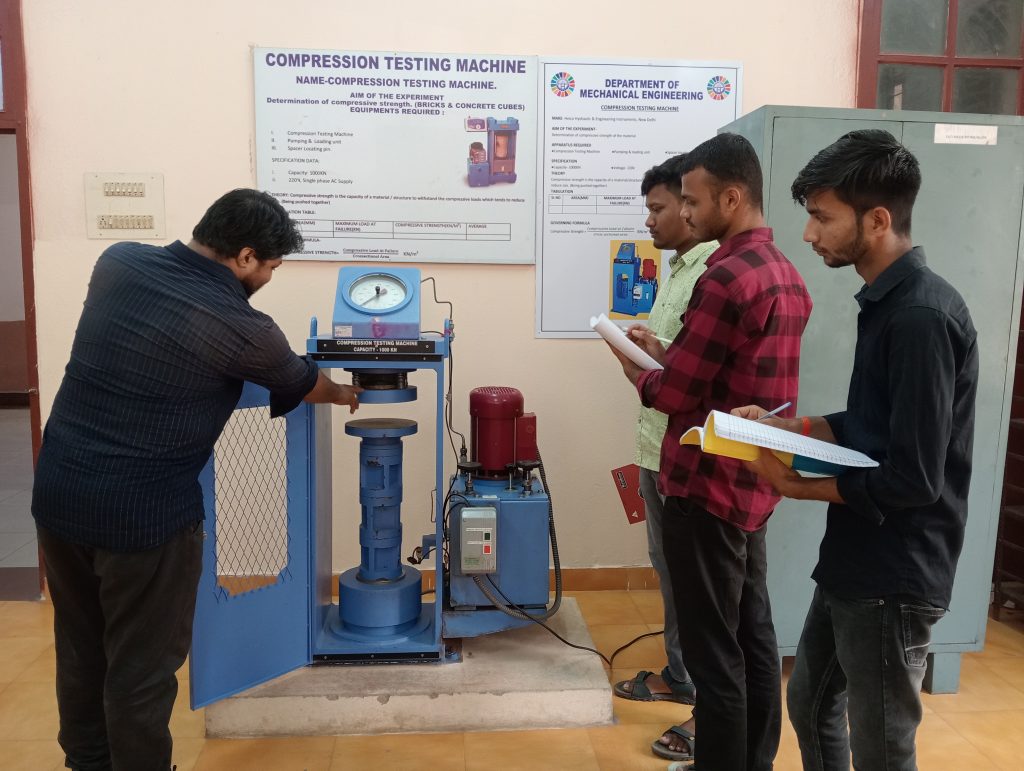
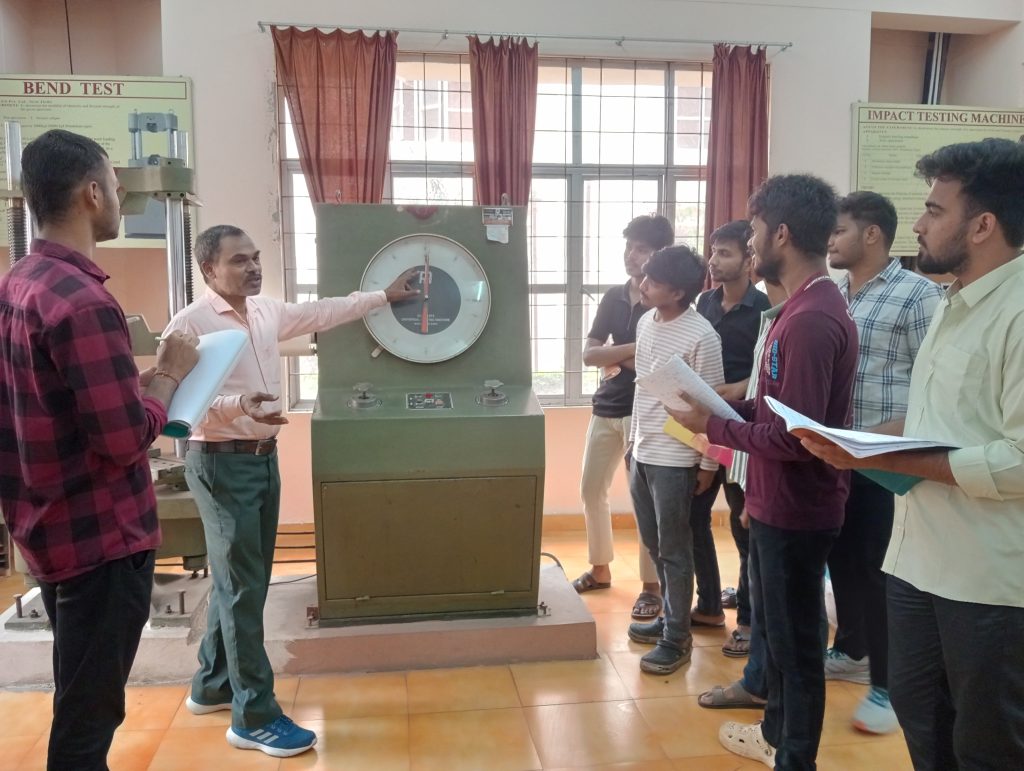
  1. Determination of tensile strength of materials by Universal Testing Machine.
  2. Determination of compressive strength of materials by Universal Testing Machine.
  3. Determination of bending strength of materials by Universal Testing Machine.
  4. Double shear test in Universal Testing Machine.
  5. Determination of rigidity modulus of material.
  6. Determination of fatigue strength of material.
  7. Estimation of spring constant under tension and compression.
  8. Load measurement using load indicator and load cells.
  9. Strain measurement using strain gauge.
  10. Stress measurement using strain rosette.

Thermal Engineering Lab

Course Objective

This laboratory course aims to provide students with practical experience in analyzing and evaluating
thermal systems and processes. Through this course, students will learn to conduct experiments, interpret
experimental data, and apply the principles of thermodynamics and heat transfer to real-world engineering
problems, thereby enhancing their understanding of thermal engineering concepts.

List of Experiments

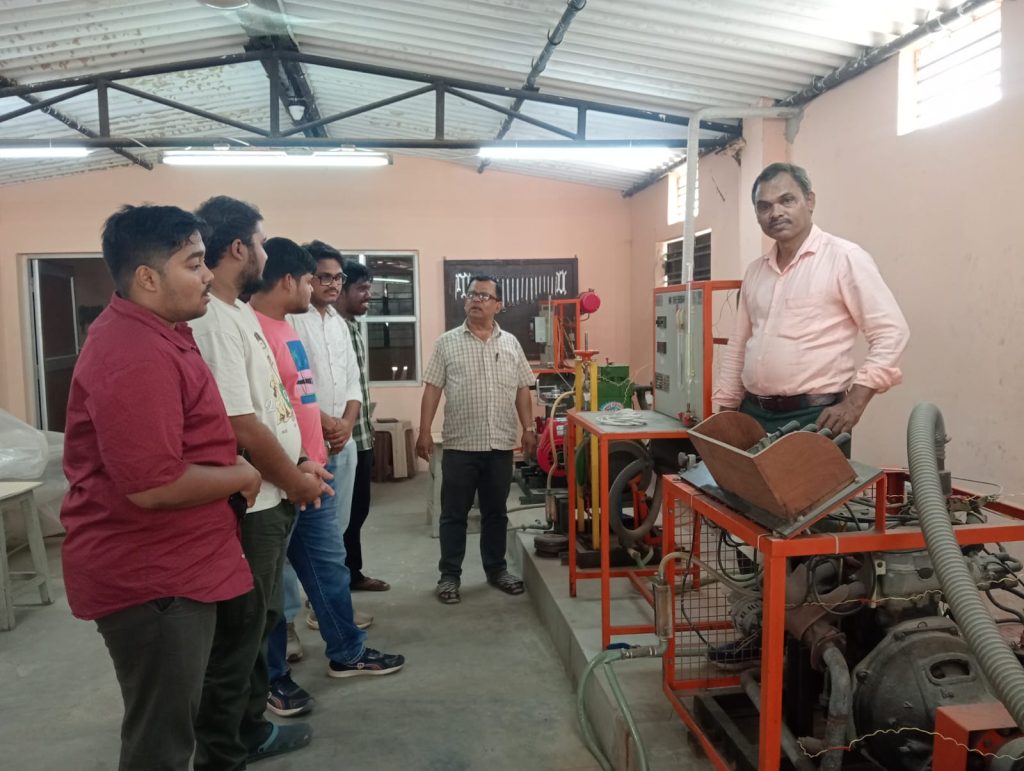
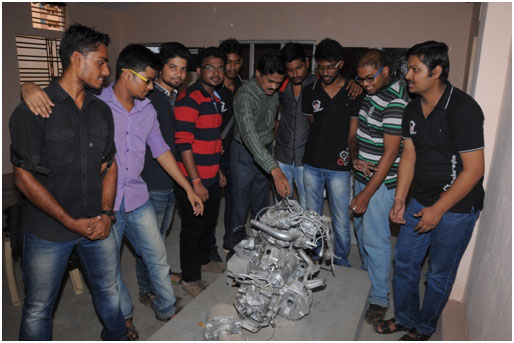
  1. Study of cut-sections of 2-stroke and 4-stroke diesel engine/petrol engine.
  2. Study of steam power plant.
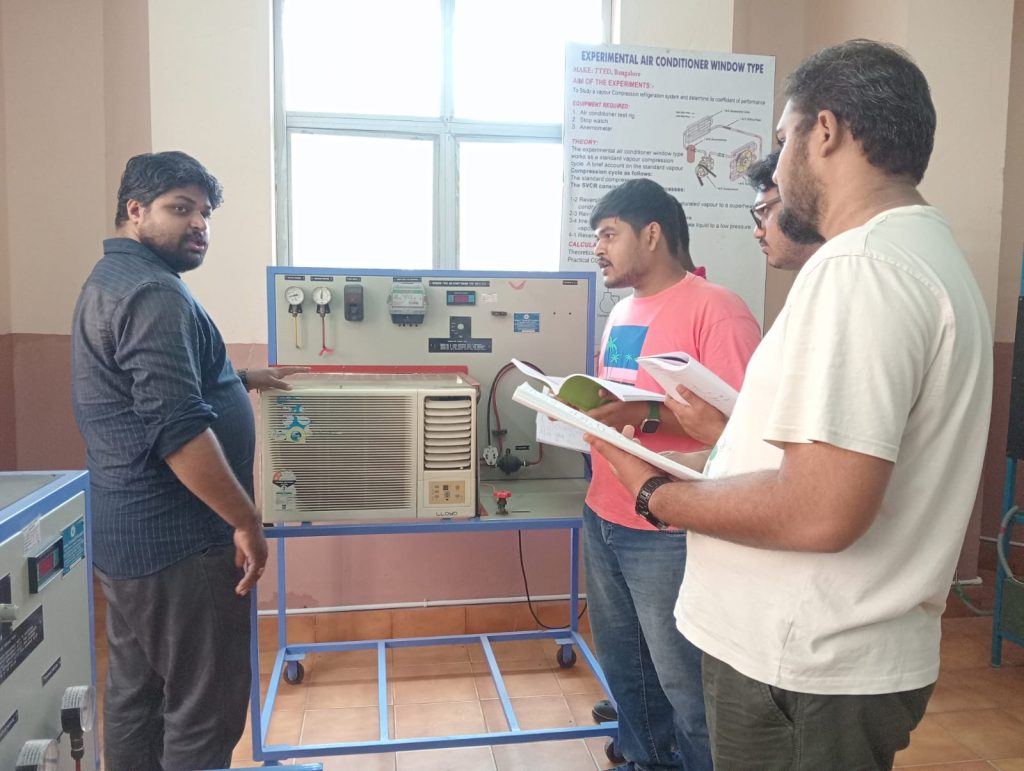
  3. Study of refrigeration system.
  4. Study of gas turbine power plant.
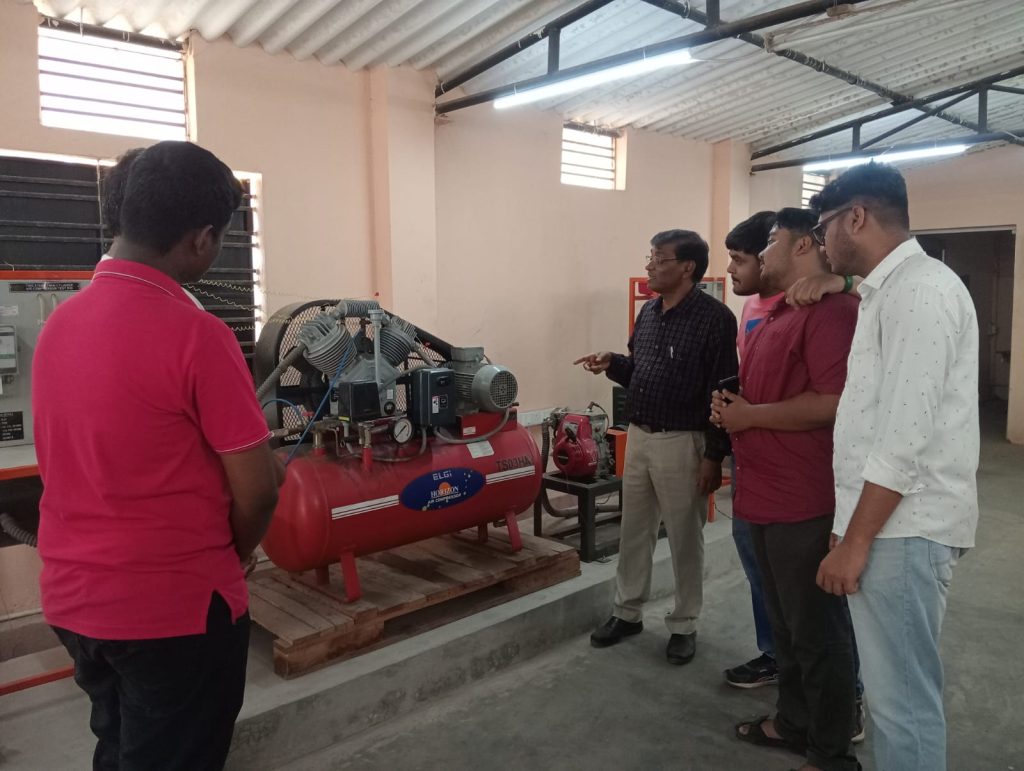
  5. Performance analysis of reciprocating air compressor.
  6. Performance analysis of centrifugal / axial flow compressor.
  7. Determination of performance characteristics of gear pump.
  8. Load test on 4-stroke single cylinder C.I. engine.
  9. Load test on 4-stroke single cylinder S.I. engine.
  10. Morse test on multi-cylinder S.I. or C.I. engine.

Programming Internet of Things Lab

Overall Course Objectives

To empower students with a comprehensive understanding of IoT and Embedded Systems, Arduino and
Raspberry Pi platforms, and C and Python programming. This will enable them to create innovative
IoT designs and products and understand how these devices interact with the physical world.
Students will also learn debugging techniques and network protocols essential for embedded systems.

Module 1: Introduction to Internet of Things and Embedded Systems [12 Hours]

This module introduces the significant role of the Internet of Things (IoT) in the modern world
and explores future trends in connected technologies. It explains the concepts of IoT and
embedded systems, their components, and their impact on society. The module covers the interaction
between hardware and software in IoT devices and the role of operating systems in supporting
embedded applications.

Students will also learn the fundamentals of networking, including device connectivity, the
structure of the Internet, and the concept of network protocols. Additionally, the module introduces
Mobile Ad-Hoc Networks (MANETs) and their relevance to IoT systems.

Sub Topics:

  • Embedded Systems Hardware and Software
  • Networking and the Internet
  • What is the Internet of Things (IoT)?

Formative Assessments:

4 quizzes and 4 peer-review assignments.

Module 2: The Arduino Platform and C Programming [13 Hours]

This module provides detailed knowledge of the Arduino platform, including the physical board,
libraries, and the integrated development environment (IDE). Students will learn how to program
Arduino boards using C language and understand the role of shields in extending hardware capabilities.

The module covers reading Arduino board schematics, installing and using the Arduino IDE,
understanding libraries, and running programs. It also introduces C programming fundamentals
including variables, data types, operators, loops, conditionals, and functions.

Additional topics include the Arduino build process, structure of Arduino sketches, accessing
pins on the board, debugging embedded systems, and UART serial communication protocols.

Sub Topics:

  • Arduino Environment
  • Arduino Programs
  • C Programming Basics
  • C Operators
  • Arduino Sketch Structure

Formative Assessments:

4 quizzes and 4 peer-review assignments.

Module 3: The Raspberry Pi Platform and Python Programming [19 Hours]

The Raspberry Pi is a small and affordable single-board computer used to design and develop
practical IoT devices. In this module, students will learn how to set up the Raspberry Pi
environment, install and run a Linux operating system, and execute Python programs.

Students will explore Python-based integrated development environments (IDEs) for Raspberry Pi
and learn techniques for tracing and debugging Python programs. The module also introduces
hardware and operating system features of the Raspberry Pi platform.

Sub Topics:

  • Raspberry Pi Processor
  • Operating System Benefits
  • Raspberry Pi Configuration
  • Navigating the File System
  • Linux Graphical User Interface
  • Python Programming on Raspberry Pi

Formative Assessments:

4 quizzes and 4 peer-review assignments.

Learning Outcomes

On successful completion of the course, students will be able to:

  1. Understand and define key concepts of the Internet of Things (IoT) and its societal impact.
  2. Understand the design considerations and components of IoT devices.
  3. Program the Arduino development board and use shields and libraries effectively.
  4. Compile and execute programs using C programming language for embedded systems.
  5. Set up and operate the Raspberry Pi platform with a Linux operating system.
  6. Develop Python programs on Raspberry Pi and debug them using appropriate tools.
  7. Understand networking fundamentals including Internet structure and network protocols relevant to IoT devices.

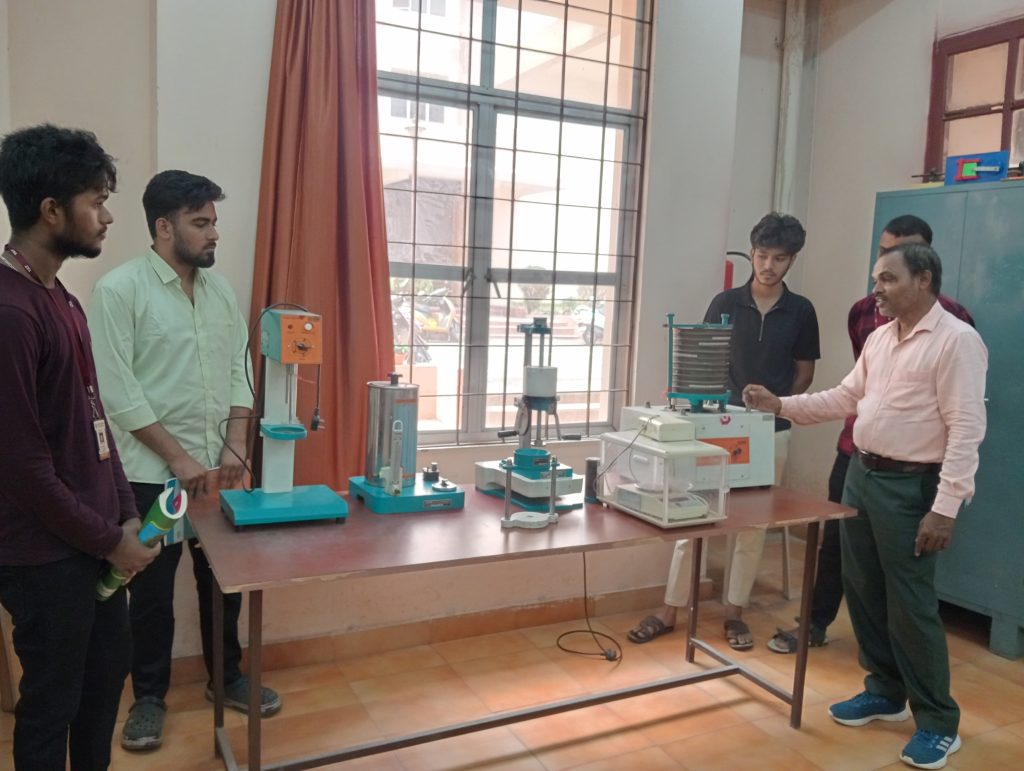
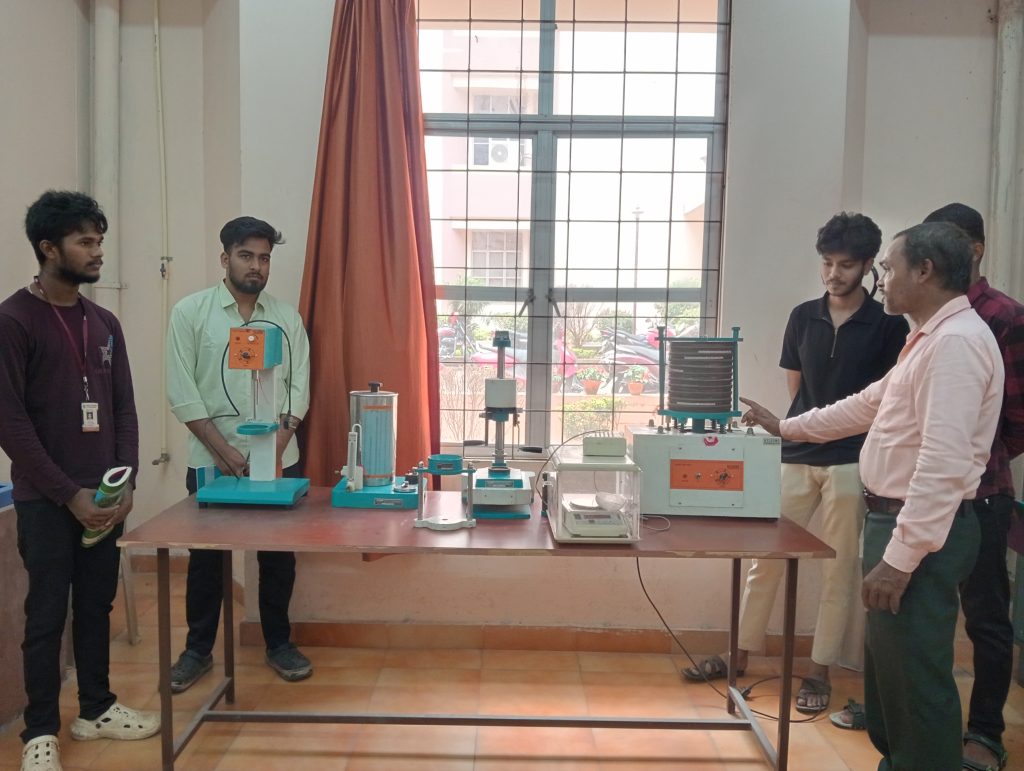
Basic Manufacturing Processes Lab

List of Experiments

  1. Determination of grain size.
  2. Determination of clay content and permeability of moulding sand.
  3. Preparation of pattern and study of foundry practices.
  4. Practice and preparation of jobs through arc welding.
  5. Practice and preparation of jobs through oxy-acetylene welding.
  6. Determination of strength of brazed and soldered joints.
  7. Practice and preparation of jobs using sheet metal forming processes such as forming and deep drawing.
  8. Demonstration of different types of rolling mills.
  9. Demonstration of extrusion processes.

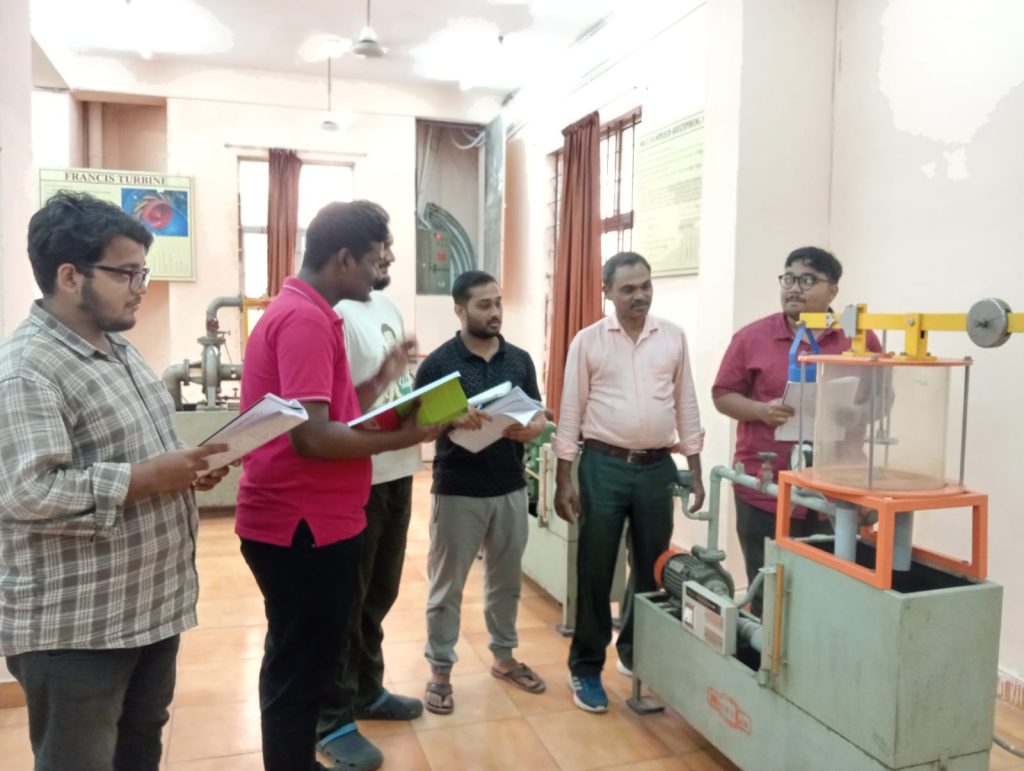
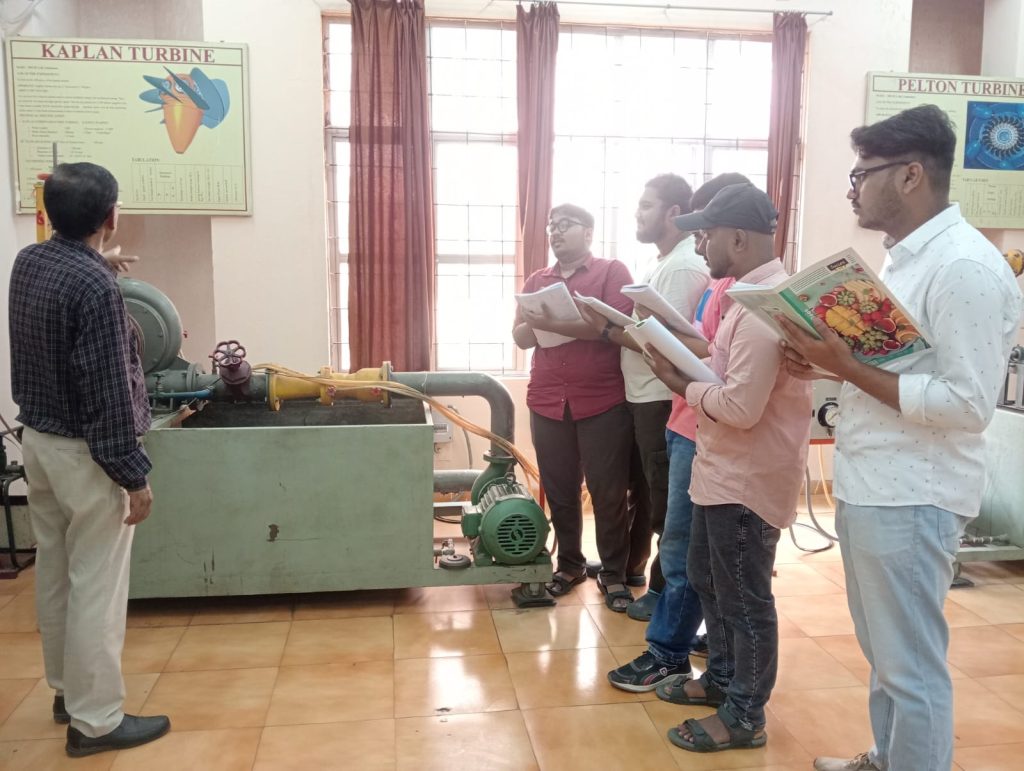
Fluid Mechanics and Fluid Machinery Lab

Objective

To study the flow measurement techniques and analyze the performance characteristics of various fluid machinery through practical experiments.

List of Experiments

  1. Calibration of venturimeter.
  2. Pressure measurement with pitot-static tube.
  3. Determination of pipe flow losses.
  4. Verification of Bernoulli’s theorem.
  5. Flow visualization by Hele-Shaw apparatus.
  6. Performance test on centrifugal pump.
  7. Performance test on reciprocating pump.
  8. Determination of viscosity of a fluid.

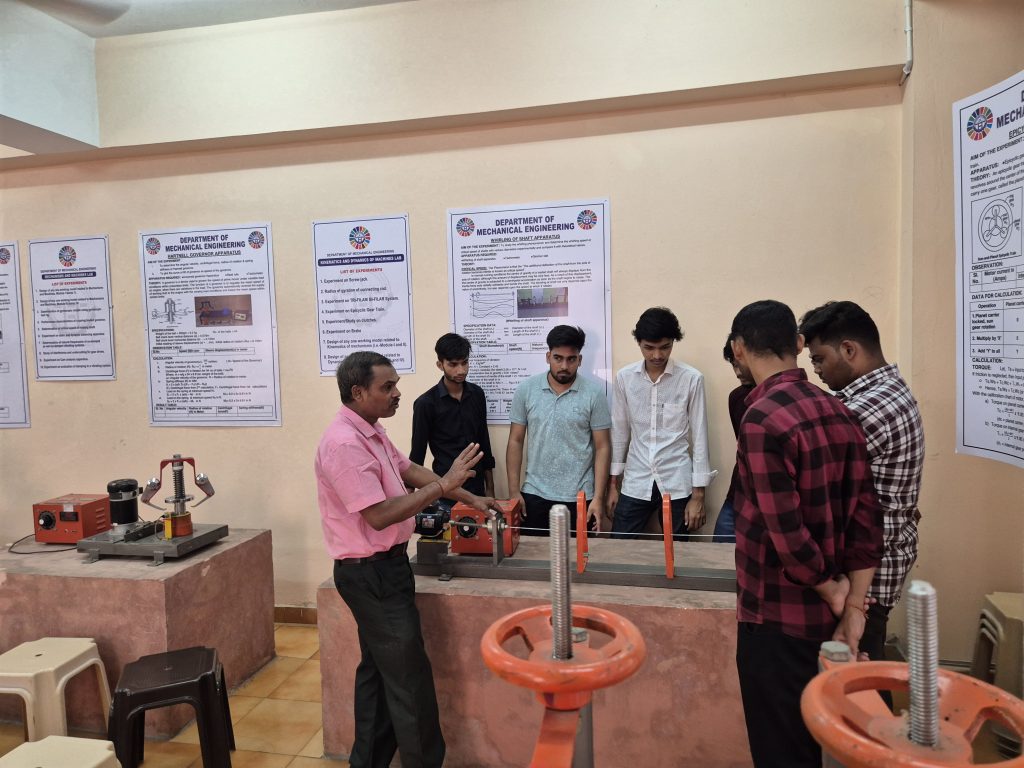
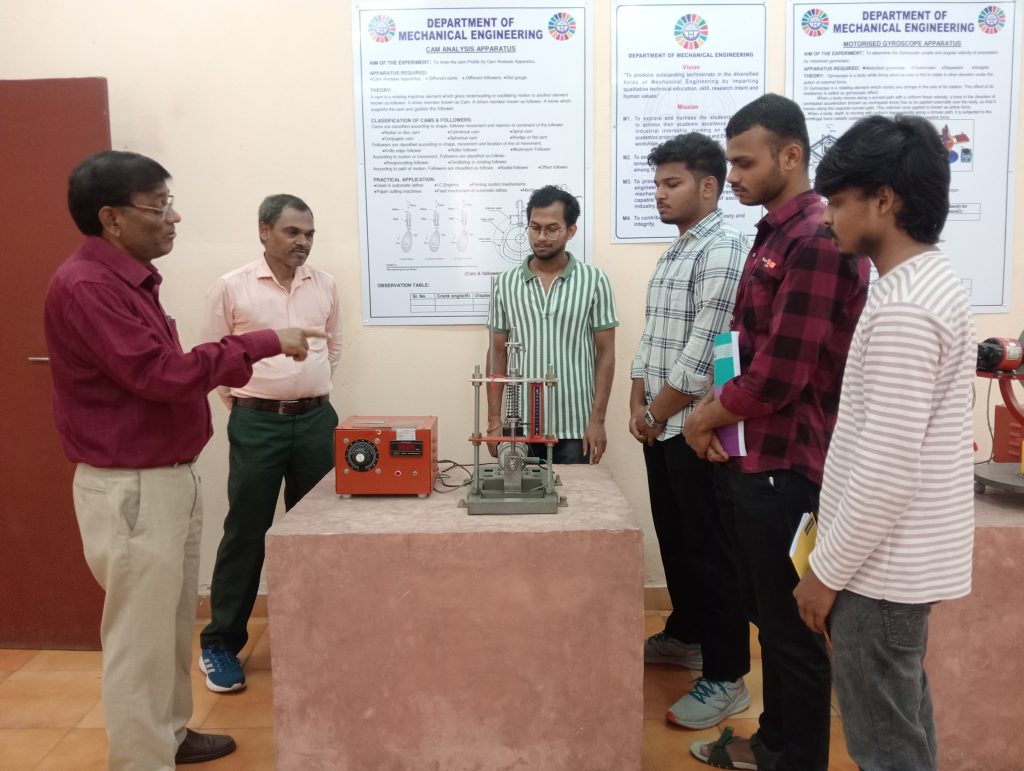
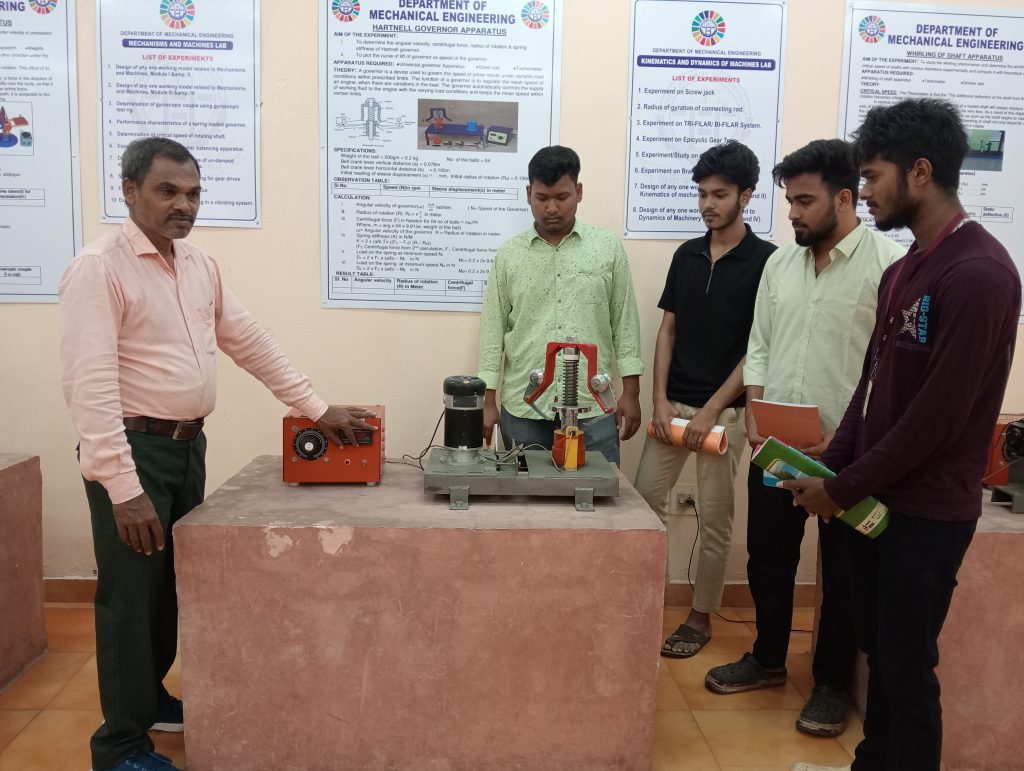
Machines and Mechanisms Lab

List of Experiments

  1. Design of any one working model related to Kinematics & Dynamics of Machines (Module I & II).
  2. Design of any one working model related to Kinematics & Dynamics of Machines (Module III, IV & V).
  3. Experiments on simple, compound and reverted gear trains.
  4. Study of interference and undercutting for gear drives.
  5. Determination of moment of inertia of a flywheel.
  6. Study of performance characteristics of a spring-loaded governor.
  7. Experiment / study on screw jack.
  8. Experiment / study on clutches.
  9. Experiment on static and dynamic balancing apparatus.

Design of Machine Elements-I Lab

List of Experiments

  1. Design of riveted joint.
  2. Design of welded joint.
  3. Design of cotter joint.
  4. Design of knuckle joint.
  5. Design of shaft.
  6. Design of flexible coupling.
  7. Design of rigid coupling.
  8. Design of helical spring.
  9. Design of journal bearing.
  10. Design of elements of roller bearing.

Design of Machine Elements - II Lab

Course Objectives

This laboratory course provides hands-on experience in designing critical machine elements
such as cranks, pistons, shafts, clutches, brakes, and gear systems. Students will apply
theories of failure and fatigue analysis to solve practical design problems, reinforcing
theoretical concepts through computational and analytical exercises.

List of Experiments

  1. Problems for practice on theories of failure.
  2. Problems for practice on fatigue failure.
  3. Design of crank, piston and cylinder.
  4. Design of connecting rod and shaft.
  5. Design of clutches.
  6. Design of brakes (block brake, band brake and internal expanding brake).
  7. Design of belt, rope and chain drives.
  8. Design of spur, bevel and helical gears.

Machining Lab

Course Objectives

This laboratory course provides hands-on experience in fundamental machining operations,
including turning, milling, grinding, and threading. Students will analyze tool geometry
using ASA and ORS systems, measure cutting forces, and evaluate the role of coolants in
machining processes. Emphasis is placed on developing practical skills in operating
lathes, milling machines, and grinding machines for manufacturing precision components.

List of Experiments

  1. A study on tool geometry in both ASA and ORS systems.
  2. Preparation of a threaded joint using drilling and tapping operations.
  3. Perform operations such as taper turning, thread cutting, knurling, and groove cutting on a lathe machine.
  4. Determine the cutting forces during turning of a cylindrical component on a lathe machine.
  5. Perform gear cutting on a milling machine.
  6. Working with shaper, planer, and slotting machines.
  7. Working with surface grinding and cylindrical grinding machines.
  8. A study on the importance of coolant during machining.

Soft Computing Lab

Course Objectives

This laboratory course introduces soft computing techniques such as fuzzy logic, neural networks,
and genetic algorithms using MATLAB and Python. Students will design fuzzy systems, implement
perceptron models, and solve optimization problems. The course emphasizes hybrid systems
(GA-ANN/Fuzzy) and real-world applications such as thermal system modeling, CFD optimization,
and robotics path planning.

List of Experiments

  1. Introduction to MATLAB/Python Fuzzy Logic Toolbox / scikit-fuzzy – Create a simple fuzzy inference system (FIS).
  2. Application of Fuzzy Logic in mechanical systems.
  3. Introduction to Neural Networks in MATLAB / Python (TensorFlow/Keras) – Implement a perceptron model.
  4. Application of Artificial Neural Networks (ANN) in mechanical engineering.
  5. Introduction to Genetic Algorithms – Implement a basic GA using MATLAB / Python (DEAP library).
  6. Solving optimization problems using Genetic Algorithms – Example: Design optimization of truss structures, springs, or shafts.
  7. Study of Hybrid Soft Computing Systems – Combining GA with ANN/Fuzzy for performance enhancement.
  8. Case Study / Mini Project – Example: Thermal system modeling, CFD optimization, or robotics path planning.
  9. Simulation and Analysis of soft computing models – Performance testing, model comparison, and analysis using real data.

Project for Product Development - I Lab

Course Objectives

This course aims to develop students’ ability to plan, manage, and evaluate product development
projects. Students will learn how to analyze market and customer needs, apply structured product
development models, and propose strategies for successful product launches in real industrial
contexts.

Learning Outcomes

Upon completing the course, students are expected to be able to:

  • Plan and independently execute projects aimed at collecting, systematizing, and analyzing
    information about markets and customer contexts as key inputs for product development in
    different industrial sectors.
  • Apply important models for organizing and managing product development and their
    implementation in practical commercial settings.
  • Analyze complex product development situations and propose suitable strategies, plans,
    and action programs for different types of organizations.
  • Identify the need for additional knowledge and tools (analytical and computer-based)
    required to conduct product development tasks.
  • Critically evaluate the outcomes of a product development project and reflect on
    uncertainties and risks involved in implementation.

Instruction

The course is organized as an independent project carried out in teams of 4–5 students.
Each team develops an idea into a product concept ready for market launch for a specific company.
The project work is supported through methodological lectures that guide students in applying
product development tools and techniques.
Throughout the course, project progress is presented during a series of seminars where
opposition groups act as “control gates”. These sessions provide feedback and
evaluation at different stages of development. The course concludes with a final seminar
where the opponent group assesses the project and decides whether the product should
be launched or not.

IC Engines & Heat Transfer Lab

IC Engines Experiments

  1. Performance test on a 4-stroke diesel engine – Determine brake power, indicated power, mechanical efficiency, BSFC, and heat balance.
  2. Performance test on a 4-stroke petrol (SI) engine – Evaluate power output, fuel consumption, and overall efficiency.
  3. Morse test on a multi-cylinder petrol engine – Determine indicated power of each cylinder.
  4. Retardation test (motoring test) – Determine frictional power of the engine.
  5. Study of fuel-injection systems – In-line pump, rotary pump, CRDI systems, and injection characteristics.

Heat Transfer Experiments

  1. Heat transfer by natural convection – Determine heat transfer coefficient from a vertical or horizontal cylinder/plate.
  2. Heat transfer by forced convection – Determine the convective heat transfer coefficient in a forced air flow duct.
  3. Thermal conductivity of insulating material – Measure thermal conductivity using a guarded hot plate or heat flow meter.
  4. Heat transfer in a shell-and-tube heat exchanger – Determine LMTD and overall heat transfer coefficient.
  5. Radiation heat transfer experiment – Study Stefan-Boltzmann law and emissivity measurement (optional).

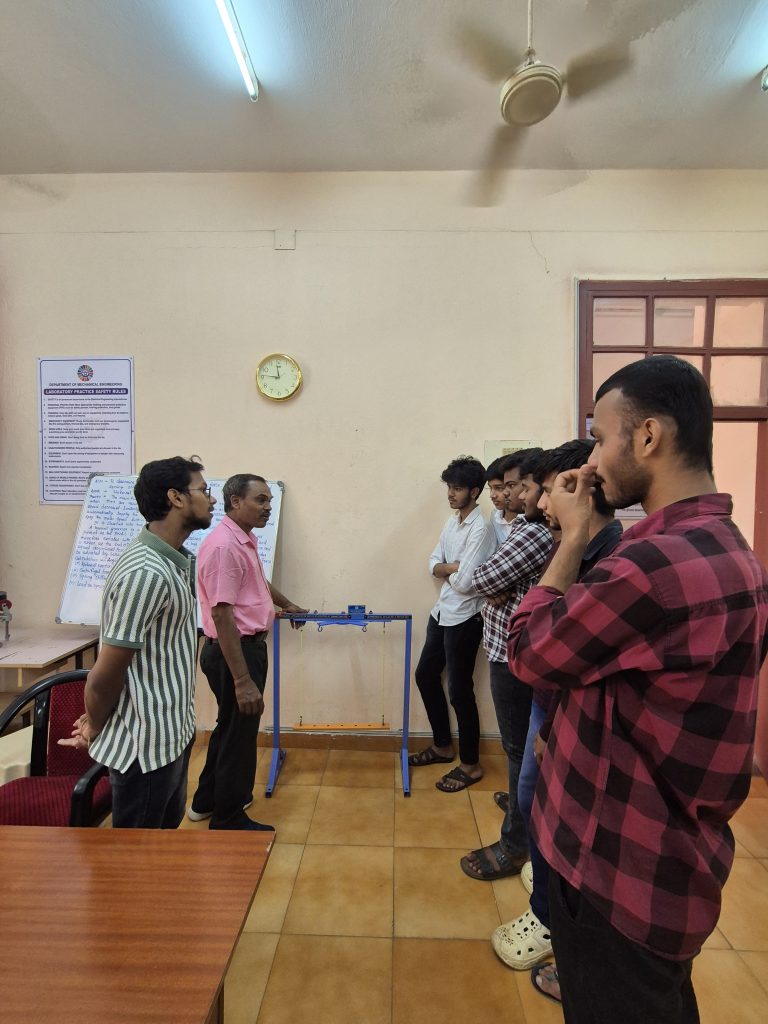
Mechanical Vibration Lab

List of Experiments

  1. Mass – Spring System.
  2. Simple and Compound Pendulums.
  3. Mass Moment of Inertia Estimation – Part I: Bifilar Suspension Method.
  4. Mass Moment of Inertia Estimation – Part II: Auxiliary Mass Method.
  5. Forced Vibration with Negligible Damping.
  6. Transverse Vibration of a Beam.
  7. Undamped Vibration Absorber.
  8. Static and Dynamic Balancing.

ADDITIONAL LABS

EV TECH LAB

An Electric Vehicle Technology Lab as an additional lab facility has been set in the department to impact the latest technology on Electric Vehicles to the students. This lab is equipped with two EV 2 wheelers (Wokinawa make) with one 2 Wheeler cut section model where students are exposed to hands on practice of assembling and dismantling of all EV components. Besides, this lab houses 3 special sections with three wall display TV Units for Mechanical, Electrical and Electronics sections where students are imparted training and demo with EV power train live model, battery pack, traction motor and controller, battery management system and diagnostic tools.

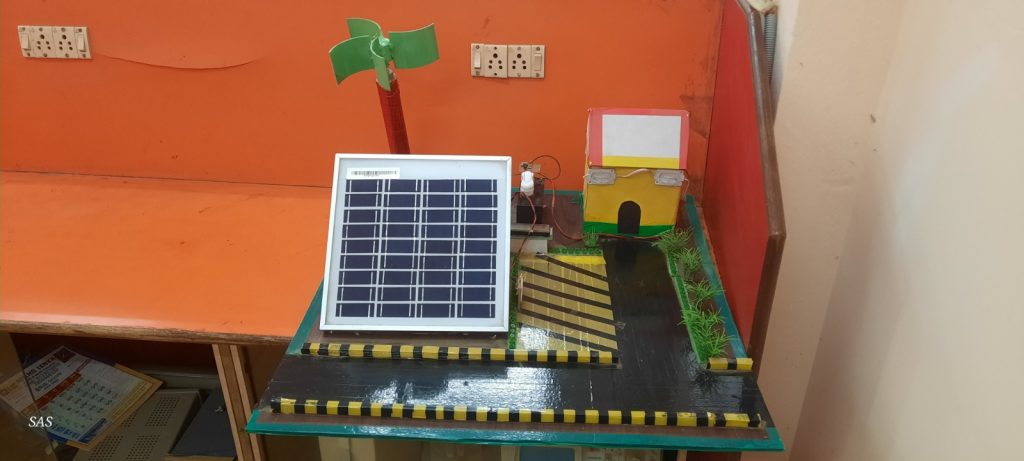
RENEWABLE ENERGY LAB

A special lab of sustainability solar and wind energy has been setup with 500 watt field model wind turbine, a vertical axis Tulip model and a blade less suction model for students training and practices on the renewable energy technology. Besides, this lab is equipped with PV solar panels, solar off-grid setup, solar nano-grid to study the parameters of solar PV system using MPPT and PWM controller.

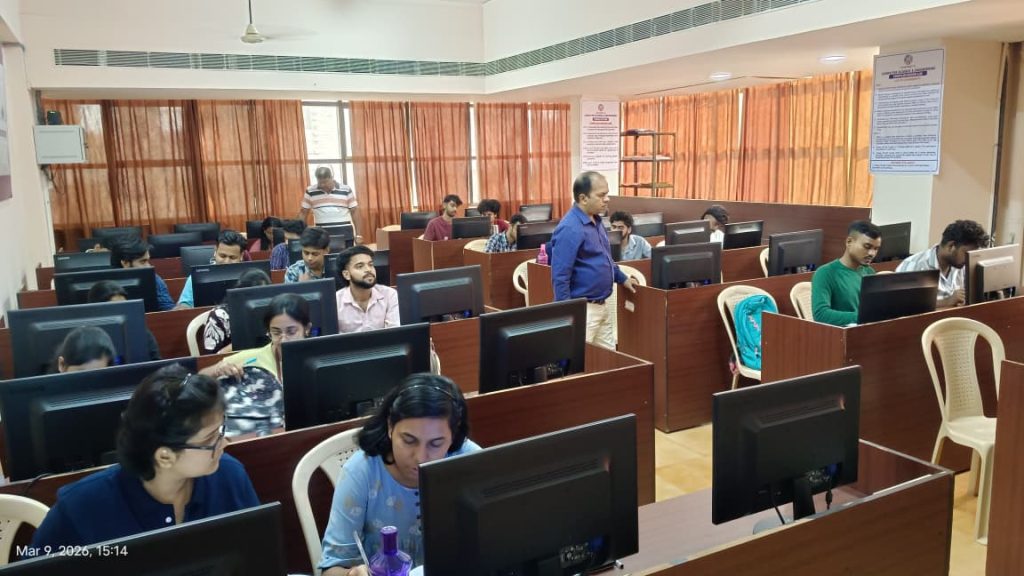
CAD/CAM/CAE Lab

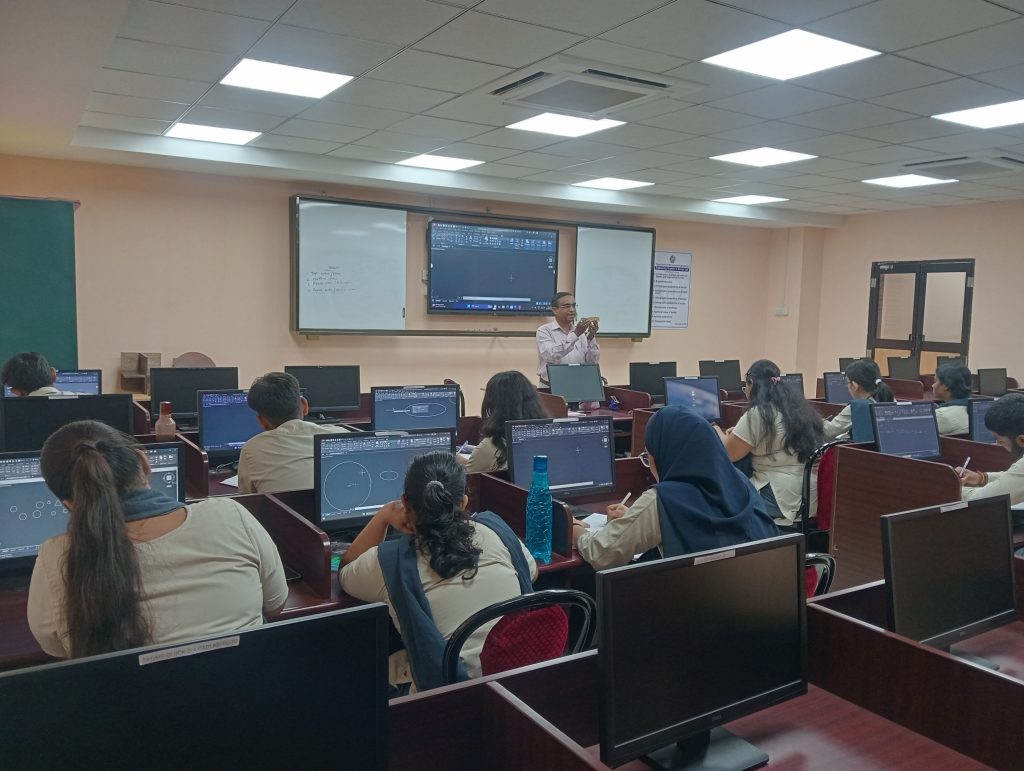
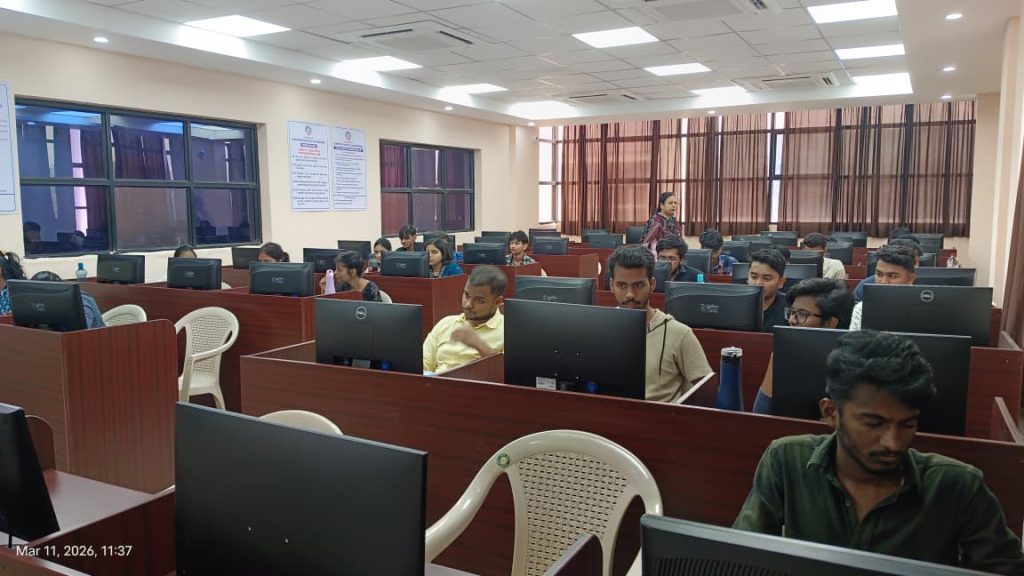
CAD / CAM Laboratory

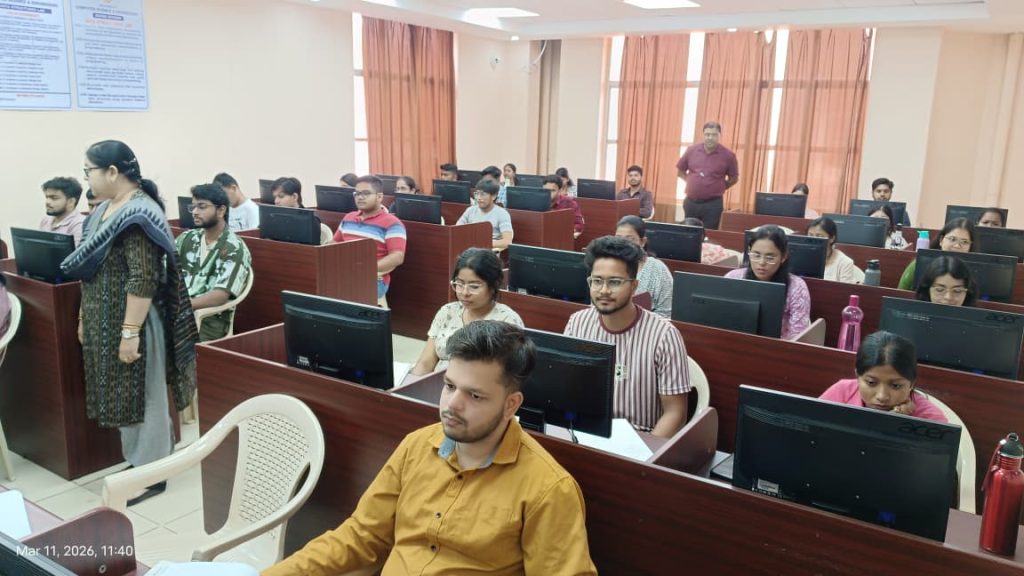
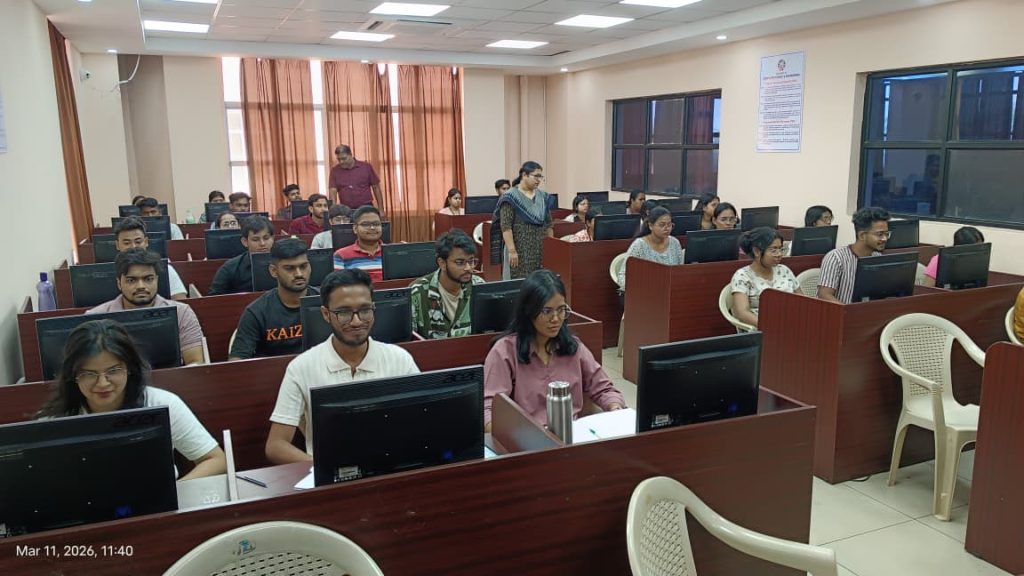
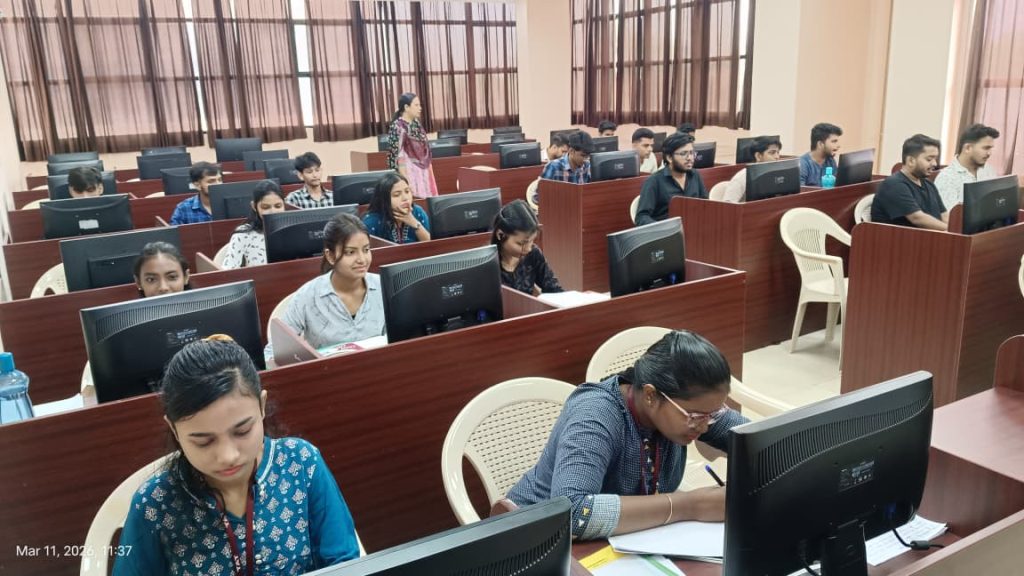
CAD/CAM laboratories provide significant engineering benefits by integrating Computer-Aided Design (CAD) and Computer-Aided Manufacturing (CAM) processes. This integration enables engineers and students to design, analyze, and manufacture components efficiently within a unified digital environment. By combining design and manufacturing workflows, CAD/CAM technology improves productivity, reduces design time, and enhances product accuracy and quality.

Key advantages of CAD/CAM laboratories include easy creation of complex 3D models, rapid design modifications, automated generation of CAM codes, and direct integration with manufacturing systems. These capabilities support faster prototyping, efficient production planning, and better product development processes.
Key Benefits for Students

Design Efficiency and Accuracy: CAD tools enable students to create precise 2D and 3D models quickly. They allow easy editing and modification of designs while maintaining high drawing quality and accuracy. Advanced simulation and analysis features also help identify design issues early in the development stage.
Manufacturing Integration (CAM): CAD models can be directly transferred to CAM systems to generate CNC toolpaths and machine instructions. This seamless integration reduces manual errors, improves efficiency, and significantly saves time during the manufacturing process.

Common Software and Tools Used

  • CAD Software: AutoCAD, CATIA, Pro/ENGINEER, Solid Edge, Siemens NX, Creo, Fusion 360
  • CAM & Analysis Tools: ANSYS for engineering analysis and CNC programming using G and M codes